
Money in Punta Cana: USD vs Pesos, Tipping, and Cards
Complete guide to handling money in Punta Cana — currencies, ATMs, tipping rules, scams to avoid, and how to budget for your trip.
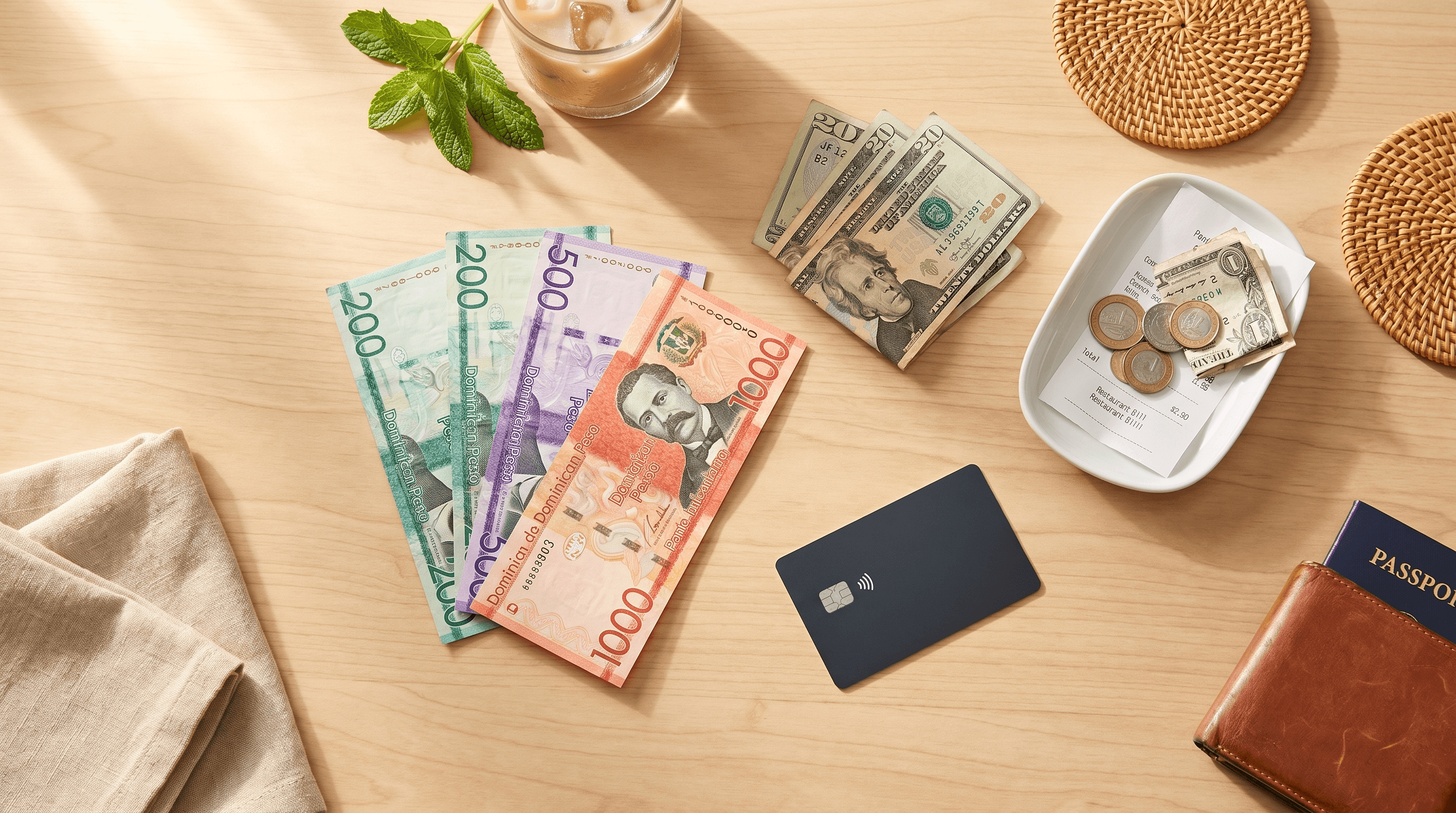
Money is one of the most confusing aspects of a Punta Cana trip for first-time visitors. Two currencies are in circulation, tipping rules aren't always obvious, ATM access varies, credit cards work in some places and not others, and the difference between resort prices and outside-the-resort prices can be enormous. This guide walks through everything you need to know to spend confidently in the Dominican Republic without overpaying or feeling lost.
If you have specific questions about how payments work for any of our trips, contact our team — we accept multiple currencies and payment methods and can clarify the right approach for your booking.
The Two Currencies: USD and Dominican Pesos
The official currency is the Dominican peso (DOP), but US dollars circulate freely throughout the tourist zones. In Punta Cana, Bávaro, and Cap Cana, you can pay for almost anything in either currency. Outside the tourist zones — in Higüey, Veron, Santo Domingo neighborhoods, or any small town — pesos are strongly preferred and dollars may not be accepted at all.
The exchange rate at the time of writing hovers around 58 to 62 Dominican pesos per US dollar, though it shifts with market conditions. For mental math, a useful approximation is that 1,000 pesos is roughly 17 US dollars. Many restaurants and tour operators display prices in both currencies, and prices in USD are usually rounded for convenience (e.g., $20 instead of 1,180 pesos).
Which Currency Should You Carry?
If you're staying inside the resort zone for most of your trip, USD is the simplest option. The resorts, taxis arranged by hotels, restaurants in Bávaro, and major excursion operators all accept dollars without issue. If you plan to leave the resort even occasionally — to visit local towns, eat at family restaurants, shop in markets, or take public transportation — bring some pesos. A useful target is about 50 percent USD and 50 percent pesos for a balanced trip.
Where to Exchange Money
Avoid the airport currency exchange counter if possible. The rates are typically the worst you'll find. The best exchange rates are at official Dominican banks (Banco Popular, BHD, Banreservas) which have branches in Bávaro and Punta Cana proper. Banks require your passport for any exchange transaction. Rates are slightly worse at the official currency exchange offices (casas de cambio), but they're faster and require less paperwork.
Never exchange money with informal street changers, even if the rate sounds great. The risk of counterfeit notes is real, and there's no legal recourse if something goes wrong. The rate difference between street exchangers and banks is rarely worth the risk.
ATMs in Punta Cana
ATMs are widely available in the resort zones. The major bank ATMs (Banco Popular, Banreservas, BHD) dispense both pesos and US dollars, though pesos are more reliable and offered at every machine. ATM withdrawal fees vary: your home bank typically charges a foreign transaction fee (often $3 to $5 per withdrawal plus a percentage), and the Dominican ATM operator charges its own fee (usually around 250 to 350 pesos, or roughly $4 to $6).
Practical advice: withdraw larger amounts less frequently. Pulling out 8,000 to 10,000 pesos at once minimizes the per-withdrawal fees compared to multiple smaller withdrawals. Most ATMs have a single-transaction limit of around 10,000 pesos, but you can often run two transactions back-to-back if you need more cash. Always use ATMs inside banks, hotel lobbies, or well-lit shopping areas — never standalone outdoor ATMs late at night.
Credit and Debit Cards
Credit cards work at all major resorts, most restaurants in tourist zones, large excursion operators, supermarkets, and bigger shops. Visa and Mastercard are universally accepted; American Express and Discover are accepted at some major resorts but less frequently elsewhere. Outside the tourist zones, cards are accepted at supermarkets and gas stations but not at most small restaurants, market stalls, taxis, or comedores. Always carry some cash for these situations.
Important: tell your bank or card issuer before traveling that you'll be using your card in the Dominican Republic. Fraud detection systems frequently flag and block Caribbean transactions for cardholders who don't notify them in advance, and resolving a blocked card from abroad is frustrating. A simple online notification or app message before your trip prevents the problem entirely.
Foreign Transaction Fees
Most US and European credit cards charge a foreign transaction fee of 1 to 3 percent on every purchase in the Dominican Republic, even if the merchant charges you in USD. The exception is cards specifically marketed as travel cards (Chase Sapphire, Capital One Venture, several European travel cards, and similar). If you travel internationally even occasionally, getting one of these cards before your trip pays for itself quickly.
Dynamic Currency Conversion
Some Dominican card terminals will offer to charge you in your home currency rather than in pesos or USD. This is called "dynamic currency conversion," and the exchange rate they use is almost always worse than your bank's rate. When given the option, always choose to be charged in the local currency (DOP). Your bank will handle the conversion at a much better rate than the merchant's terminal does.
Tipping Culture in the Dominican Republic
Tipping is expected throughout the tourism industry. The standard rates are clear but not always communicated to visitors. Here's the practical breakdown.
At Resorts
All-inclusive resorts technically include service in the package price, but tips are still expected and appreciated. Recommended amounts: 1 to 2 USD per drink for bartenders if you want consistent good service; 2 to 3 USD per day for housekeeping (leave it on the pillow daily, not at the end); 5 to 10 USD per day for butler service if your room has one; 2 to 5 USD per bag for porters; 1 to 2 USD per round for poolside servers. Tips at the buffet are not necessary but appreciated for table servers who are particularly helpful.
At Restaurants
Most Dominican restaurants automatically add a 10 percent service charge ("propina legal" or "servicio") plus 18 percent ITBIS (sales tax) to the bill. The 10 percent service charge is technically the tip, but it doesn't always reach the server in full. The custom is to leave an additional 5 to 10 percent in cash directly on the table for the server, especially for good service. Check the bill carefully — restaurants in tourist zones sometimes add the service charge plus a separate tip line, which is double-tipping.
Taxis and Transportation
Taxis in the Dominican Republic typically don't expect a tip on top of the metered or negotiated fare, but rounding up to the nearest dollar or 50 pesos is appreciated. For pre-arranged hotel transfer drivers, 5 to 10 USD per driver is standard. Tour operators usually have a guide and a driver; tipping both is customary — 10 to 15 USD per guide and 5 to 10 USD per driver for a half-day, doubled for a full-day excursion.
Excursion Crews
On boat excursions, snorkeling trips, and day tours, the crew works hard and depends on tips. The standard is 5 to 10 USD per person for a full-day excursion, more if the experience was exceptional. Tip the crew directly at the end of the trip, not the office or booking agent. On our excursions we provide guidance during the trip about who is on the crew and how tips are distributed.
Common Scams and How to Avoid Them
The Dominican Republic is generally safe for tourists, but a few specific money scams target visitors. Knowing about them in advance is most of the protection.
Counterfeit Notes
Counterfeit pesos appear occasionally, especially in change given at busy markets or by informal taxi drivers. Real Dominican pesos have visible watermarks, holographic strips on larger denominations, and a slightly textured feel. Be wary of soft, smooth, or unusually crisp notes — and never accept change in a denomination higher than the bill you paid with.
Inflated Taxi Fares
Some taxi drivers, particularly at the airport or near major resort entrances, will quote tourists fares two to three times the local rate. The protection is simple: agree on the price before you get in, in writing or with the driver clearly confirming verbally. Ask your hotel concierge for typical fares to common destinations before you leave so you have a baseline. For a fair price reference, the airport-to-Bávaro fare in 2025 ranges from $30 to $45 USD depending on the resort.
"Helpful" Strangers Near ATMs
Someone offering to help you use an ATM, even if they seem to work nearby, is almost always a scammer. Decline politely and complete the transaction alone. If something seems off with the ATM, cancel and use a different one. Real bank employees never approach customers at ATMs.
Excursion "Special Deals" at the Beach
Beach hawkers selling excursions at the resorts often quote prices significantly higher than the legitimate operator price and may not deliver the trip as described. Book excursions through established operators with verifiable reviews, your hotel concierge, or directly with companies like ours rather than informal beach sellers.
A Realistic Budget for Your Trip
Beyond the all-inclusive cost of your hotel, here are realistic daily spending estimates for typical trip components. These are not the cheapest possible costs — they're what most travelers actually spend.
- Excursions: $80 to $150 USD per person for most full-day group trips; $200 to $400 USD per person for premium private experiences
- Off-resort meals: $15 to $30 USD per person for lunch at a tourist-zone restaurant; $5 to $12 USD per person at a local comedor
- Drinks at non-resort bars: $5 to $8 USD per cocktail; $2 to $4 USD per local beer
- Taxi for typical trips: $15 to $30 USD for short hops within Bávaro; $40 to $80 USD for longer day trips to Higüey or Bayahibe
- Tipping budget: $20 to $40 USD per day for a couple staying at an all-inclusive resort with one excursion
- Souvenirs and shopping: highly variable; cigars, rum, and coffee are good quality and reasonable prices; jewelry and art are negotiable
Resort Prices vs. Outside-the-Resort Prices
One of the bigger surprises for first-time visitors is the price difference between resort restaurants/shops and local establishments. A cocktail that costs $1 to $4 at a comedor in Veron can run $10 to $15 at a beachfront resort bar. A whole grilled fish meal at a Bayahibe fish shack might be $12 to $18; the same plate at a resort a la carte restaurant easily hits $35 to $45. A bottle of water at the resort gift shop is sometimes $4; the same bottle at a colmado outside is 40 pesos (around 70 cents).
This isn't unreasonable on the resort's part — they're paying for infrastructure, all-inclusive service, and convenience — but it's worth knowing if you want to manage spending. If you leave the resort even occasionally, plan to do some shopping for souvenirs, snacks, drinks, and small gifts at local stores rather than the resort gift shop. The savings on a week of small purchases easily covers an extra excursion.
Bank Hours and Banking Logistics
Public holidays close all banks completely. The big ones to know are January 21 (Our Lady of Altagracia), February 27 (Independence Day), Holy Week (the Thursday and Friday before Easter), May 1 (Labor Day), August 16 (Restoration Day), and the days around Christmas and New Year. Plan to have cash on hand for those dates because lines at functioning ATMs can be long and many smaller exchange offices close as well. Hotel front desks can sometimes do small dollar-to-peso exchanges in a pinch but at unfavorable rates, so it's better to plan ahead.
Paying for Excursions and Tours
Excursion booking practices vary widely. Established operators (including us) typically take a deposit at the time of booking — often 25 to 50 percent of the total — with the balance due before the trip starts, sometimes in cash on the day. Smaller operators may want full payment upfront. Hotel-arranged excursions usually bill to your room and you settle at checkout, which is convenient but rarely the best price.
If you're paying a balance in cash on the day of the excursion, bring it in the exact amount and the agreed currency. Drivers and guides don't always carry change, and trying to break a $100 bill at 7:00 AM before a Saona departure has slowed down many trips unnecessarily. If the operator quoted you in USD, pay in USD; if they quoted in pesos, pay in pesos. Mixing currencies for a single payment introduces conversion confusion that's easier to avoid.
Refund and Cancellation Policies
Read cancellation terms before booking, especially for trips that depend on weather (boat trips, fishing, snorkeling). Reputable operators offer full refunds or rescheduling when weather forces a cancellation, but the policies on weather-affected-but-not-cancelled trips (rough seas, partial visibility) vary widely. Our booking policies are transparent — we tell you exactly what happens in each scenario before you pay anything.
Cash Backup Strategies
Even with cards and ATM access, having a cash reserve matters. The recommended setup for a one-week trip: carry about $200 to $300 USD in mixed denominations from home, plus a credit card and a debit card from different banks. Pull pesos from an ATM on arrival or day two. Keep $100 or so in cash in your hotel room safe as an emergency reserve, separate from what you carry day-to-day.
If your card gets blocked or lost, having a separate card from a different bank is the single most useful backup. Wire transfers via Western Union or MoneyGram are available throughout the country and can be used as a last-resort cash injection if cards completely fail. Your hotel's front desk can usually help you locate the nearest agent.
What to Do If Your Card Is Lost or Stolen
Call your card issuer immediately — the toll-free fraud numbers usually work from the Dominican Republic, though you may need to dial through a local prefix. Most major banks can ship a replacement card to an international hotel address within 2 to 3 business days. File a police report at the local station; you'll need it for insurance claims and sometimes for your bank's fraud investigation. Keep a printed list of your card numbers and customer service phone numbers in your luggage, separate from your wallet, before you leave home.
Final Thoughts
Money management in Punta Cana isn't complicated once you understand the basics: bring both currencies, use major bank ATMs sparingly to avoid fees, notify your bank before traveling, tip generously where appropriate, agree on taxi fares in advance, and pay in local currency when given the option on card terminals. The Dominican Republic is genuinely good value for travelers who pay attention to these basics.
If you'd like advice on payment options for a specific trip you're considering, our team at Punta Cana Excursions handles bookings in multiple currencies and can walk you through the right setup for your group. We're locals — we know which approach works best for which type of trip, and we'll save you the trial and error.