Zip-Line & Adventure Park Guide for Punta Cana
Scape Park vs Bávaro Adventure Park: Hoyo Azul cenote, combo passes, height/weight limits, ACCT safety standards, and how to pick the right park.
Punta Cana has two main adventure parks that dominate the zip-line and aerial-adventure category: Scape Park in Cap Cana, and Bávaro Adventure Park in central Bávaro. Both offer zip lines, cenote swims, and combination passes with buggies, horseback riding, or other activities. They're not the same experience and they don't suit the same travelers. Understanding the differences — what each park does well, what the height and weight restrictions actually mean, and what's genuinely worth the price for your group — saves you from booking the wrong one and being disappointed.
This guide walks through the two main parks, the third-party zip-line operators in the region, what zip-line safety actually looks like at a well-run park, height and weight limits, combo pricing, and the practical question of which option fits your group. If you'd like help arranging a specific park visit or combo package, contact our team — we can match you to the park that fits your group's mix of thrill-seekers and relaxers.
Scape Park, Cap Cana: The Premium Option
Scape Park is a 400-acre nature-adventure park inside the gated Cap Cana resort area, about 15 minutes from most Punta Cana resorts. It's the higher-priced of the two main parks and the more nature-immersive experience. The signature attraction is the Hoyo Azul cenote — a natural sinkhole at the base of a 70-meter cliff filled with electric-blue mineral water — but the park has eight zip lines (including one with an ocean view, a rarity), a via ferrata climbing route, cave exploration, waterfalls, and cultural exhibits.
The Zip Line Circuit
Scape Park's zip line circuit is built into the natural limestone cliff geography. Eight lines of varying length take you over the tree canopy and along the cliff face, with the final lines crossing open ground for the longest, fastest rides. The first lines are short warmups; the back half is where the experience accelerates. The whole circuit takes about 90 minutes including walking between platforms, briefings, and short rest stops.
Hoyo Azul
Hoyo Azul ("Blue Hole") is the visual highlight. Reached via a 15 to 20 minute walk through tropical vegetation, the cenote sits at the base of a sheer cliff with water of an almost unreal turquoise color, created by the dissolved limestone and the angle of light. The swim is the moment most visitors remember and photograph most. Water temperature is cool (around 24°C / 75°F) compared to the warm Caribbean, so the swim feels refreshing rather than warm-bathwater. The cenote has been protected as a natural feature and is one of the most-photographed natural sites in Punta Cana.
What Else Is Included
The full-day pass also includes the Saltos Azules water park area (zip lines that drop you into a swimming pool, tarzan rope swing, water hammocks), Eco Splash family pools, Iguabonita Cave expedition, Cultural Route with replicas of Taino and colonial-era homes, and Iguanaland wildlife viewing. The park is genuinely a full-day commitment — most visitors spend 6 to 8 hours and don't do every activity.
Bávaro Adventure Park: The Combo-Activity Workhorse
Bávaro Adventure Park is the second main option, located closer to most resort areas (in the Bávaro/Veron corridor, about 5 to 15 minutes from most Punta Cana resorts depending on which side of the strip you're on). It's a more compact park than Scape Park but offers a broader mix of activity types in one venue: zip lines, buggies, Polaris ATVs, horseback riding, the Sacred River underground river expedition, and various cenotes.
The Zip Line Experience
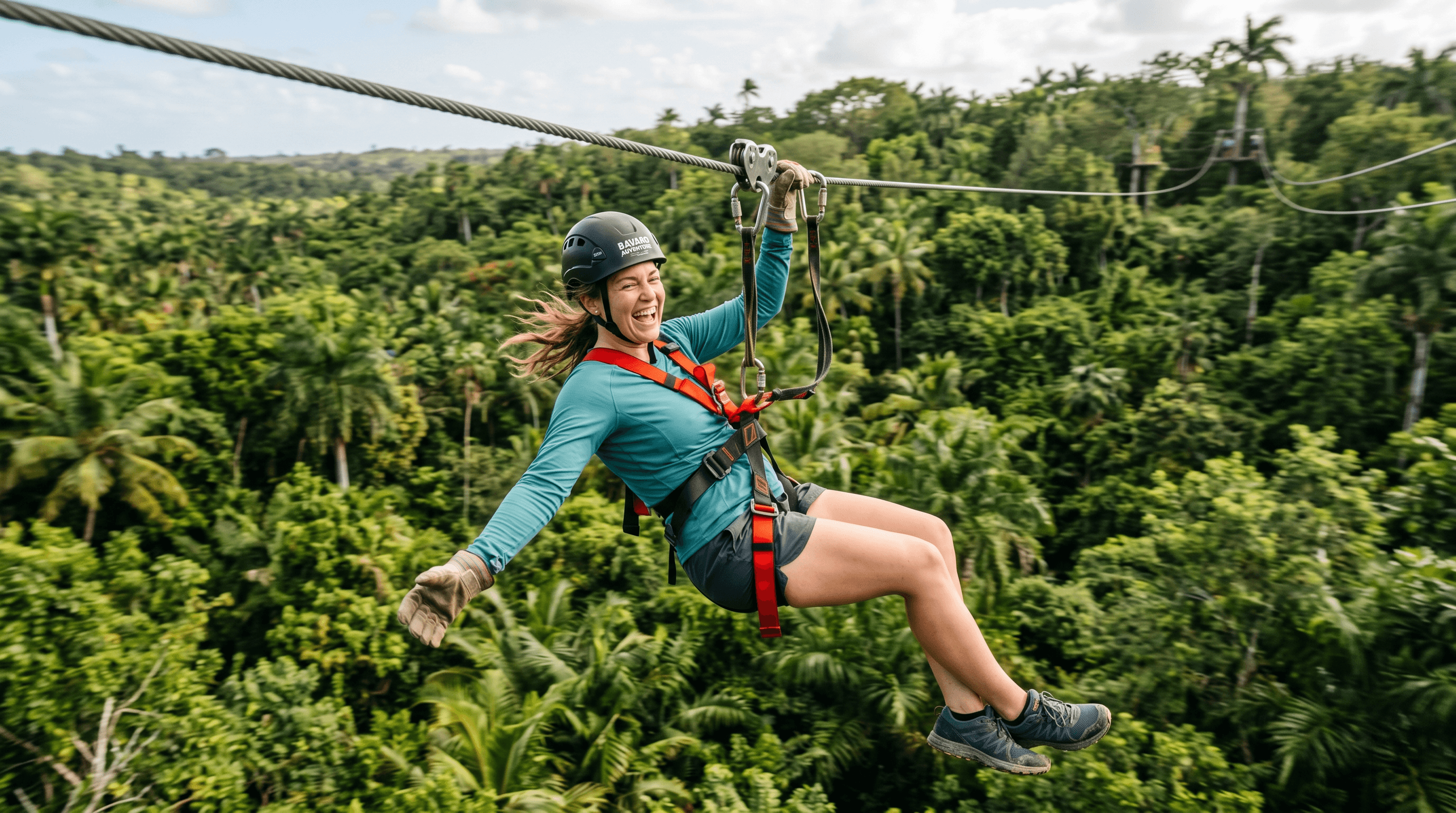
Bávaro Adventure Park's zip line circuit is 6 lines including a Himalayan hanging bridge challenge and the signature "Mega Splash" — a final cable line that drops you into a water landing pool. The Mega Splash is the gimmick that distinguishes the park's zip line experience from Scape Park's. It's a memorable finish, especially for kids and people who don't normally do zip lines. The circuit is shorter overall than Scape Park's and the lines don't have ocean views, but the format is genuinely fun.
Combo Packages — The Real Value
Where Bávaro Adventure Park excels is in combo packages. The standard offerings include: zip line + buggy, zip line + Polaris ATV, zip line + horseback riding, and full-access "mega combo" passes that include everything. For groups that want multiple adrenaline activities in one half-day, this packaging works well. The combination of zip line and buggy is the most popular, running about 4 to 6 hours total with hotel pickup, lunch, and the various activities.
Other Zip-Line Operators
Beyond the two main parks, several smaller operators run independent zip-line attractions in the region. Anamuya Mountain has a longer, more dramatic zip line course about 90 minutes inland — appealing for adventure-seekers who want more zip-line time and don't need the rest of the adventure-park infrastructure. The cost is similar but the experience is more focused on the zip-line element alone. Various smaller "adventure tour" packages also include short zip-line components as part of larger excursion bundles; these tend to be less satisfying than dedicated park visits because the zip-line portion gets compressed.
Height, Weight, and Age Restrictions
Zip lines have strict physical restrictions that often surprise families on arrival. The pulley-and-harness systems are calibrated for specific weight ranges, and operators have safety minimums and maximums they won't bend on.
Typical Limits
- Minimum age: Usually 6 to 8 years old. Children under 6 can't typically participate in main zip-line circuits, though some parks have mini-zip-line kid areas (Scape Park's Mini Scape, Bávaro's family-friendly options).
- Minimum height: 1.20 to 1.30 meters (4 to 4.3 feet) for main circuits. Some smaller starter lines accept shorter participants.
- Minimum weight: Usually 30 to 40 kg (66 to 88 lbs). Below this, the participant can't generate enough momentum on longer lines.
- Maximum weight: Usually 110 to 130 kg (242 to 287 lbs). This is a hard limit for safety reasons — exceeding it puts excessive stress on the equipment and can result in dangerous landings.
- Health restrictions: Pregnancy, recent surgery, back/neck/spine conditions, severe cardiac conditions, and vertigo all warrant skipping the zip lines. Some parks formally refuse pregnant participants regardless of trimester.
If you have group members near the weight limits in either direction, contact the park before traveling to confirm rather than risking arriving and being turned away. Parks won't refund park entrance fees just because one activity is unavailable to a particular guest.
Zip-Line Safety: What Well-Run Looks Like
Adventure-park zip lines, when properly operated, have strong safety records. The challenges arise when operators cut corners on equipment maintenance, staff training, or daily inspections. The industry's main safety body is the Association for Challenge Course Technology (ACCT), which sets the ANSI/ACCT 03-2019 standard governing zip-line design, equipment, inspections, and staff training. Major adventure parks worldwide adhere to ACCT standards or equivalent regional standards.
What to Look For
- Helmets and harnesses checked for fit: A genuine pre-ride check by staff (not just "here's a helmet, here's a harness, go"). Helmets should fit snugly without sliding.
- Briefing before the first line: Explanation of body position, braking method (if applicable to your park), what to do at platforms, what hand signals mean.
- Two-line redundancy: Most modern zip-line tours use a primary cable and a secondary safety cable. Single-line operations are older and lower-margin-for-error designs.
- Inspections visible: Look around the platform — there should be inspection logs, maintenance equipment, and clear staff procedure. A park that looks shabby probably operates the same way.
- Staff certifications: Reputable parks have ACCT-trained or equivalent-trained operators. You won't see the certification cards from the platform but the questions "how often do you inspect the cables?" and "how often is staff retrained?" should get clear answers from any guide who is asked.
What to Wear and Bring
- Closed-toe shoes: Required for all zip-line activities. Sneakers or sandals with secure straps. Flip-flops, slides, and Crocs without backstraps are typically not permitted.
- Clothes that allow movement: Shorts and a t-shirt work well. Avoid loose flowy clothing that can catch on harnesses. Skirts and dresses are generally not workable for zip-line activities.
- Swimwear under your clothes: For the Mega Splash water landing at Bávaro or the cenote swim at Scape Park.
- Lightweight quick-dry layer: Both parks have shaded sections; a thin layer helps if you're chilly after the water activities.
- Sunscreen and a hat for waiting periods: Adventure parks have a fair amount of standing in line and standing on platforms in the sun. Apply sunscreen before arriving and reapply during the day.
- Cash for tips, photos, and snacks: Photographers at the parks take action shots that you can buy as packages (typically 20 to 50 USD). Tipping guides 5 to 10 USD per person at the end of the circuit is standard for good service.
- Lockers and waterproof bag: Both parks have storage lockers; bringing a waterproof bag for the water activities helps keep your phone and wallet dry.
Which Park to Choose
Pick Scape Park if...
You want the more nature-immersive experience, you're prioritizing the Hoyo Azul cenote (this is the singular reason most visitors go), you have a full day to commit, you're staying in the Cap Cana area, or your group includes serious photographers. Scape Park looks better in photos than Bávaro Adventure Park does, and the cenote is the most-photographed natural site in Punta Cana. The downside: it's more expensive (entry packages typically 100 to 145 USD per adult, less for kids), the activities require more walking, and the day is longer.
Pick Bávaro Adventure Park if...
You want multiple adrenaline activities (zip line plus buggy plus horseback) in one day, you have kids who'll love the Mega Splash water landing, you're staying in central Bávaro and want a shorter transfer, or you want a half-day experience rather than a full day. The combo packages typically run 80 to 130 USD per person depending on which activities are included. The park is more compact than Scape Park, the experience is more activity-driven and less nature-focused, and the value proposition is the combination of activities rather than any single signature attraction.
Pick Independent Operators if...
You're an experienced zip-line enthusiast who wants longer, faster lines without the rest of the adventure-park infrastructure. Anamuya Mountain and a few other inland operators run more dedicated zip-line experiences for travelers who don't need cenotes, cultural shows, or food. These tend to be 2 to 3 hour focused excursions at 70 to 100 USD per person.
When to Book and When to Visit
Both main parks operate daily from approximately 9 AM to 5 PM. Morning visits are typically cooler and less crowded; afternoon visits get afternoon thunderstorm risk during rainy season. Most adventure parks operate in light rain but close down zip lines during electrical storms. Heavy rain doesn't usually cancel cenote swims (you're getting wet anyway) but does close zip lines and cave activities.
Book a few days in advance during high season (December through April) — the parks operate at capacity many days and walk-in availability is unreliable. Off-season booking can usually be done the day before. The earliest available time slot (typically 9 to 10 AM) gives you the best weather, the most time to do all activities, and the smallest crowds.
Zip-Line Safety Data: What the Numbers Actually Say
Zip lines look dangerous and feel dangerous in the moment, but the actual injury statistics tell a more reassuring story when proper standards are applied. Industry analyses of zip-line incidents have consistently found that the vast majority of injuries are minor (cuts, bruises, sprains) and occur during ground operations — platform mounting, dismounting, walking between platforms — rather than during the actual flight on the line. Catastrophic incidents are rare and almost universally trace back to equipment failures at operators that weren't following ACCT or equivalent inspection protocols.
Helmet use is what reduces the severity of the injuries that do occur. The CDC's HEADS UP injury prevention program notes that properly fitted helmets reduce serious head injury risk by 55 percent or more across a range of recreational activities. The major Punta Cana adventure parks all require helmets for zip-line participation and inspect harnesses before each rider — these aren't optional and trying to argue with staff who require a helmet check is a waste of energy.
If the Weather Closes the Park
Tropical weather is unpredictable, and there's always some chance of a day getting partially or fully closed by storms during your vacation. Most parks have clear weather-cancellation policies: full cancellation reschedules to the next available day at no charge; partial cancellation (e.g. zip lines closed but cenote open) is more variable. If you've booked through an operator or hotel concierge, the rebooking process is typically handled for you; direct-booking through park websites usually offers similar flexibility.
Plan adventure park visits for early in your vacation rather than the last day. If a storm closes the park on your scheduled day, you want a few flexible days remaining to reschedule rather than having no buffer. For one-week vacations, days 2 to 4 are the sweet spot for booking the adventure park — you're past arrival fatigue but still have weather flexibility.
Common Mistakes to Avoid
- Underestimating the physical demands: Adventure parks involve a lot of walking, climbing stairs, and standing. Comfortable shoes and reasonable fitness make the difference between enjoying the day and being exhausted by mid-afternoon.
- Booking the wrong combo: If your group has mixed adrenaline preferences (some thrill-seekers, some who'd rather skip the zip lines), book the park where the non-thrill-seekers have things to do. Scape Park's cenote and cultural areas work well for non-zippers; Bávaro has fewer non-zip-line attractions for those who don't want to participate in the activities.
- Wearing the wrong clothes: Shows up in flip-flops, then can't do the zip lines. Wears a long flowy dress, gets refused harness fit. Check the dress code before you go.
- Cheap third-party bookings: The lowest prices come from beach hawkers and off-brand websites selling packaged tours that may not include actual park entry. Book directly through the park websites or through a verified operator.
- Mismatched expectations: Cap Cana and central Bávaro are different vibes; Scape Park is the upscale-resort experience while Bávaro Adventure Park has a more accessible, mass-market feel. Match the choice to your group's preferences.
Final Thoughts
Punta Cana's adventure parks deliver on the basic promise — they're well-designed, mostly safe (when you book the established options), and provide a memorable break from beach time. The Hoyo Azul cenote at Scape Park is genuinely one of the most visually striking natural features in the Caribbean and the swim there is what most visitors remember from a Punta Cana vacation. The combo packages at Bávaro Adventure Park are an efficient way to do multiple adventure activities in one day. Neither is a luxury experience, but both are good-value for what they offer.
If you'd like help selecting the right park and combo package for your group's age range, fitness level, and budget, contact us with your travel dates and group composition. We'll match you to the park and package that fits, with safety standards we trust.